ANDREA CESCATO
Aerospace engineer · Milan area, Italy

Andrea Cescato

Flight control laws, flight dynamics and simulation

I design and validate control laws on nonlinear flight models in MATLAB/Simulink, from trim and linearisation to closed-loop simulation. In industry I work on safety-critical aerospace systems on Leonardo programmes: closed-loop simulation models today, DO-178C model-based avionics on the AW249 helicopter before that.

MSc Aerospace Eng., Bologna ~3 yrs aerospace industry EN C1 · FR B1 · IT native
θ cmd+0.0°
θ+0.0°
q+0.0°/s

Drag up or down on the instrument to command pitch attitude. When idle it replays the ±15° step sequence from my Cessna 172 autopilot test. The response here is an illustrative second-order model (ωn = 1.6 rad/s, ζ = 0.7), not the project data.

How I work on a control law
  1. Trimsteady flight on the nonlinear 6-DOF model
  2. LineariseA/B matrices by small perturbations
  3. Analysemodes, flying-qualities requirements
  4. Designroot locus, PID, LQR, tuning
  5. ImplementSimulink, limits and anti-windup
  6. Validateclosed-loop simulation, Monte Carlo

Projects

Figures come from my own project reports. Industrial work is proprietary and is described only in words.

Fixed-wing flight control

Cessna 172: pitch damper and pitch-attitude autopilot

University of Bologna · 2021 · team of 2

A complete design cycle on a nonlinear 6-DOF Cessna 172 model, trimmed in a steady climb at 5000 m.

  • Longitudinal and lateral-directional models linearised numerically and checked against the analytical stability derivatives; modes compared with their literal approximations.
  • Pitch damper sized from Level 1 flying-qualities criteria: short-period damping raised from 0.217 to 0.3.
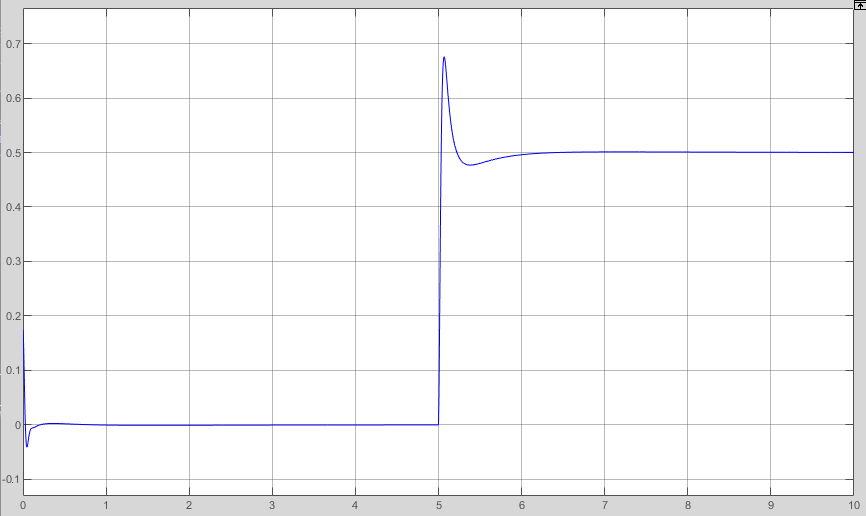
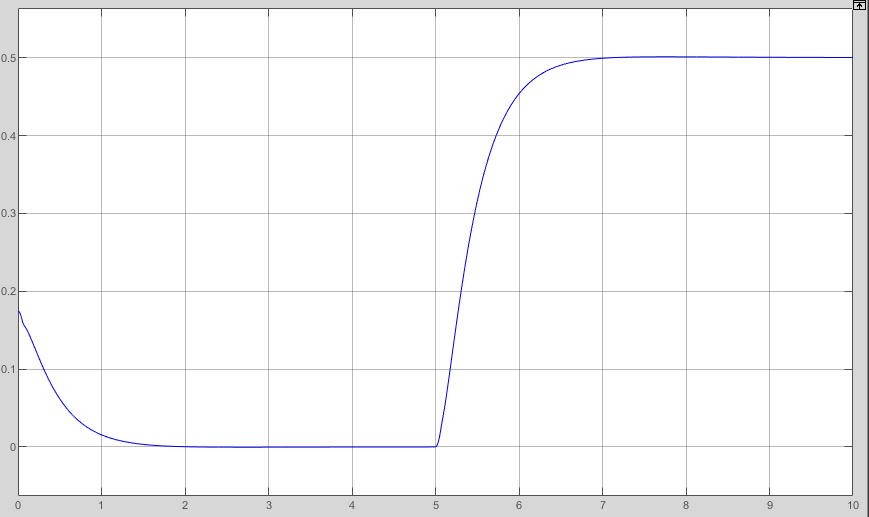
  • Pitch-attitude autopilot by root-locus compensation, implemented as a PID with ±25° elevator saturation and back-calculation anti-windup.
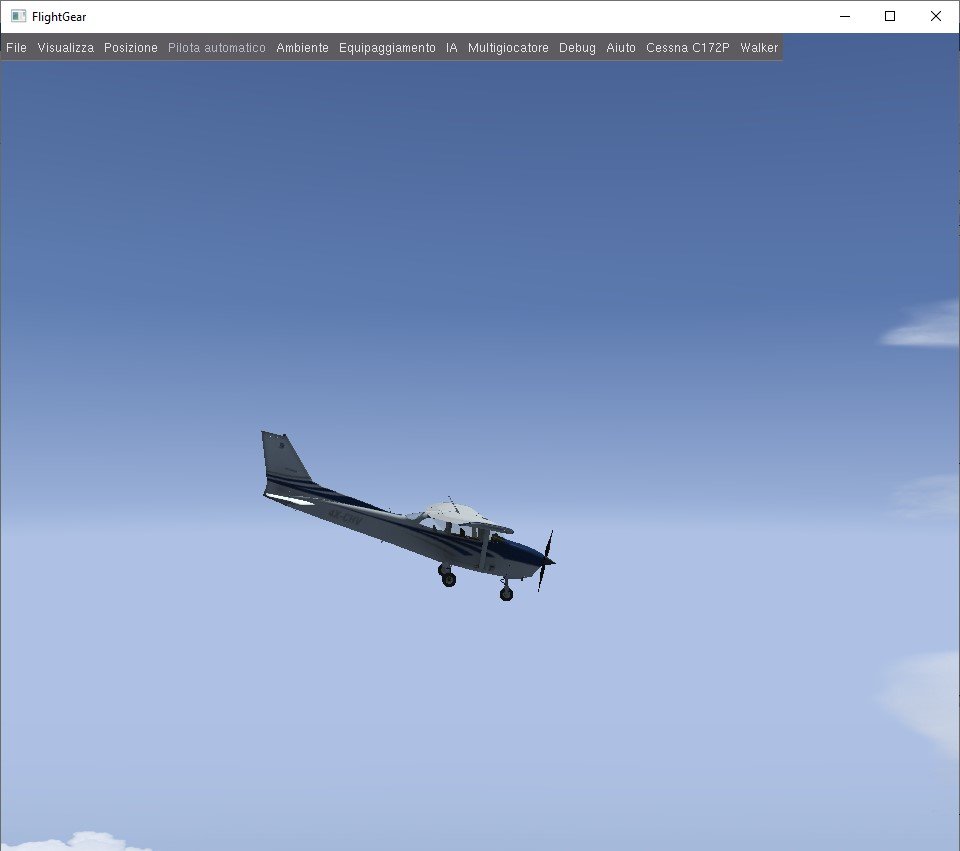
  • Closed loop run in real time with the Simulink model driving FlightGear.
0.217 → 0.3short-period damping with Kq = −0.04
±15°pitch commands tracked in FlightGear
6-DOFLinearisationFlying qualitiesPIDAnti-windupFlightGear
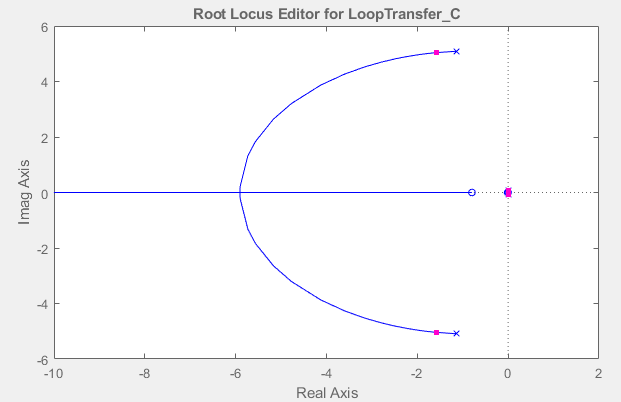
Root locus of the pitch-rate loop
Pitch damper. Root locus of the q-feedback loop.
Cessna 172 in FlightGear
FlightGear driven by the Simulink closed loop.
Step response with elevator saturation showing overshoot
0.5 rad step, saturation only: integrator wind-up overshoot.
Step response with anti-windup
Same step with anti-windup: overshoot removed.
Launch-vehicle attitude control

LQR with integral action, tuned by particle swarm optimisation

T4i Engineering · R&D internship and MSc thesis · 2023

Attitude control of a thrust-vectored launch vehicle, from nonlinear model to statistical robustness assessment.

500Monte Carlo runs on the nonlinear model
99.6%within 1° in pitch and roll after 20 s
98.2%within 3° in yaw after 20 s

Figures not shown: the work was carried out within a company internship.

6-DOFLQRPSOMonte CarloSimulink
Nonlinear modelVariable mass and inertia, aerodynamic look-up tables, thrust-vane actuator dynamics and saturation, wind.
Linear modelsLongitudinal and lateral state-space models from the nonlinear plant.
Control lawLQR with integral action for pitch, roll and yaw tracking.
Automated tuningWeighting matrices tuned by PSO on rise and settling time.
RobustnessDispersions on wind, mass, inertia, thrust and aerodynamic coefficients.
Optimal control

Space Shuttle re-entry trajectory optimisation

University of Bologna · 2021–2022 · individual

During unpowered re-entry the only controls are the angle-of-attack and bank-angle profiles. I parameterised both with 15 design variables and optimised them with the Sine-Cosine Algorithm on a 6-state model over a rotating Earth.

  • Two objectives: cross-range maximisation and peak heat-rate minimisation.
  • Terminal constraints on altitude, velocity and flight-path angle; rate bounds to exclude non-flyable oscillations.
−32%peak heat rate, heat-optimal vs cross-range-optimal
15design variables
Optimal controlConstraintsMetaheuristicsMATLAB
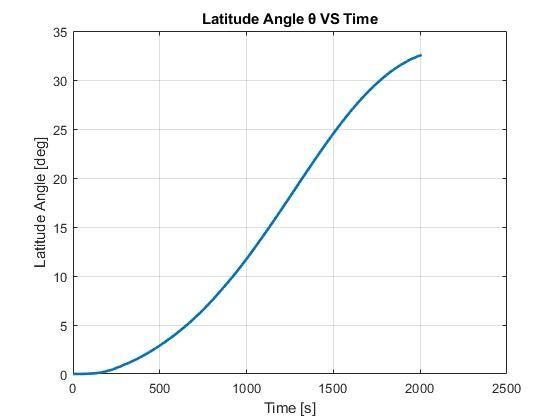
Latitude versus time, cross-range maximisation
Cross-range case: latitude reached at the terminal condition.
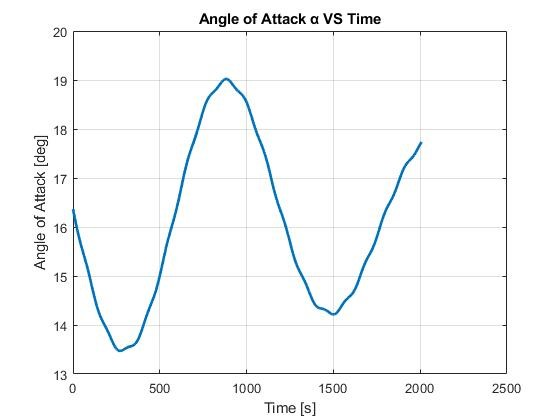
Optimised angle of attack profile
Optimised α profile, cross-range case.
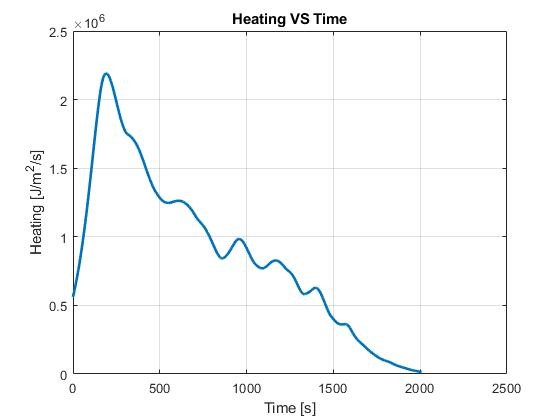
Heat rate for the cross-range solution
Heat rate, cross-range case: peak ≈ 2.2·10⁶ J/m²/s.
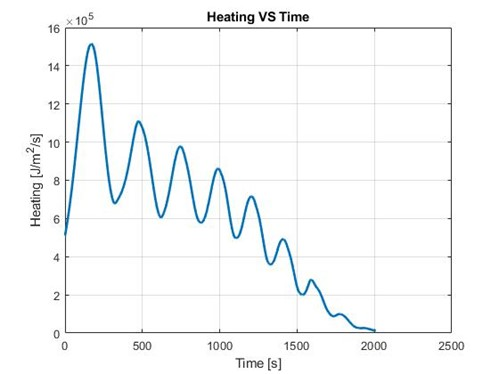
Heat rate for the heat-minimisation solution
Heat rate, heat-optimal case: peak ≈ 1.5·10⁶ J/m²/s.
BSc thesis · Padova · 2020

Launcher thrust vector control

Pitch dynamics of an unstable launcher in Simulink; PID control law by root locus with actuator saturation and anti-windup, and a full BLDC electromechanical actuator model in the loop.

Unstable plantPIDActuator model
Personal project · Python · 2026

Angles-only orbit determination

Heliocentric state of asteroid (800) Kressmannia from astrometry: Gauss IOD, Herrick-Gibbs, batch least squares, RK45, SPICE. A 2-day arc was unobservable; fusing three observatories over two months, one of which I operate, fixed it. Position within 0.1% of JPL Horizons.

github.com/andreacescato

EstimationObservabilityPython
Personal project · 2021

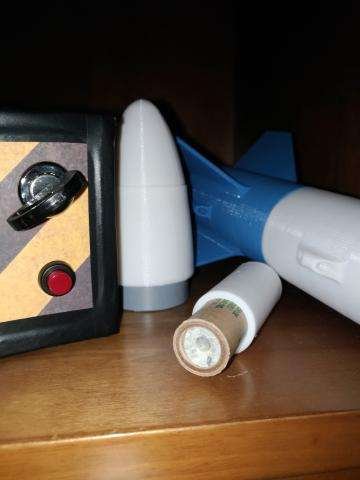
Model-rocket flight data recorder

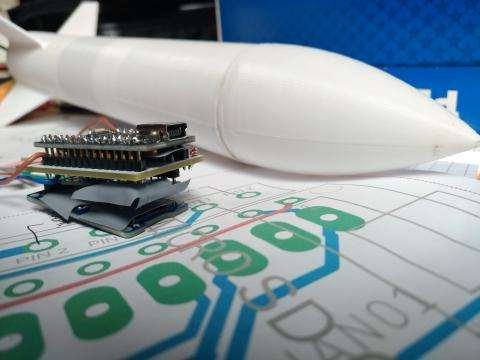
Custom PCB with Arduino Nano, IMU and data logger inside a 3D-printed nose cone I designed; flight data used to reconstruct attitude and accelerations.

Flight recorder PCB next to the nose cone3D-printed nose cone
EmbeddedIMU

Experience

Dec 2025 – now

Control Systems Engineer

Leonardo, Electronics Division · via ALTEN Italia

Simulink and C/C++ sensor models integrated into the control chain of a pointing system for closed-loop simulation; simulation test campaigns with automated execution (test time cut by 50%); requirements in IBM DOORS and architecture in SysML with Cameo.

Nov 2023 – Dec 2025

Avionic Software Engineer

Leonardo, Helicopters Division · via TXT e-Tech

Model-based components in MATLAB/Simulink for the AW249 with auto-generated code and AFDX communication, under a full DO-178C lifecycle; integration debugging of ADA and generated C code.

Feb – May 2023

Flight Control Systems Engineer, R&D internship

T4i – Technology for Propulsion and Innovation

Attitude control law of a thrust-vectoring hybrid rocket and its Monte Carlo robustness campaign.

Oct – Dec 2022

Aerospace Design Engineer, Erasmus+ traineeship

AIE Engineering, Dublin

Preliminary design of an agricultural UAV: requirements, propulsion, battery and sensor selection, endurance estimation.

2020 – 2023

MSc Aerospace Engineering

University of Bologna · taught in English · Pegasus Certificate
2017 – 2020

BSc Mechatronics Engineering

University of Padova

Flight control & dynamics

Control law design (PID, LQR, classical), stability augmentation and autopilots, flying qualities, trim and linearisation, modal analysis, saturation and anti-windup, Monte Carlo robustness.

Tools

MATLAB, Simulink, Stateflow, auto-generated code, Python, C, C++, ADA, FlightGear, Git, Linux.

Process

Requirements and traceability (IBM DOORS), MBSE with SysML (Cameo), DO-178C, simulation-based test definition and evaluation.

Get in touch

I am looking for roles in flight control laws, GNC and flight simulation, and I am open to relocating.

Email
andrea@cescato.it
LinkedIn
linkedin.com/in/andreacescato
GitHub
github.com/andreacescato
Based in
Milan area, Italy